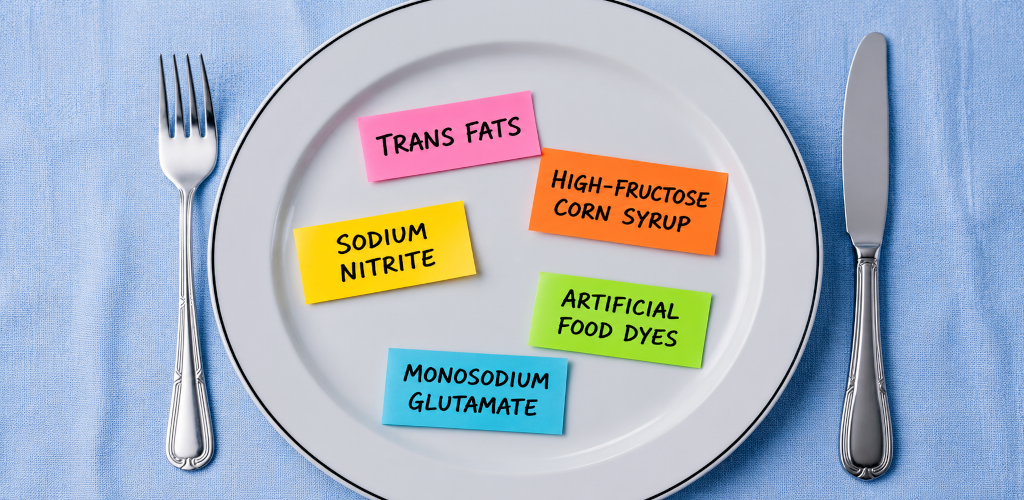
Red-flag ingredients you should know before buying your next snack.
Red-Flag Ingredients in Food
Walk through any supermarket and you’ll notice that almost every package promises to be natural, healthy, or made with real ingredients. Turn the package over, however, and the ingredient list often tells another story.
Here are five names worth recognizing the next time you read a food label.
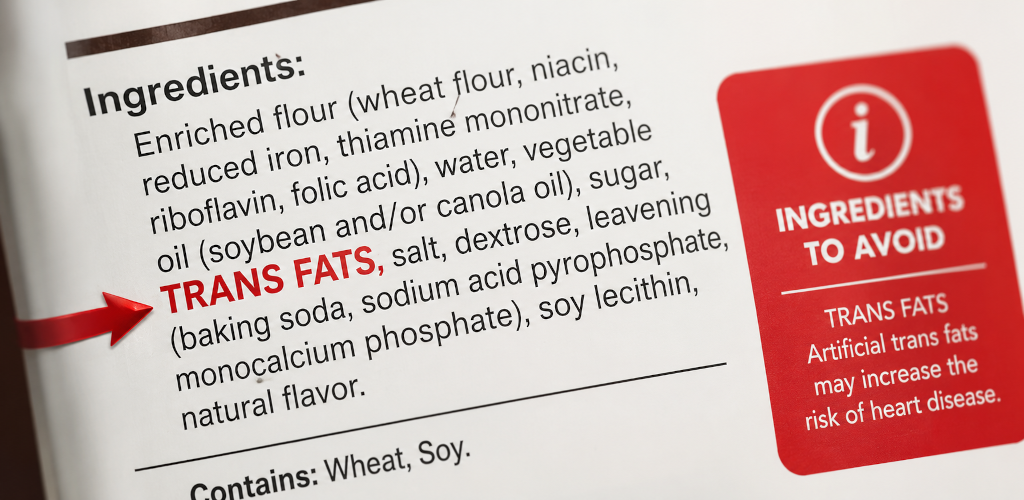
1. Artificial Trans Fats (Partially Hydrogenated Oils)
It used to be everywhere. Margarine, cookies, microwave popcorn, frozen pizza, pastries, and countless packaged snacks …
But numerous studies eventually confirmed that trans fats increase LDL (“bad”) cholesterol while lowering HDL (“good”) cholesterol, making them one of the strongest dietary risk factors for cardiovascular disease.
The World Health Organization estimates that trans fats contribute to hundreds of thousands of cardiovascular deaths worldwide every year.
Why were trans fats used for so long? Because they worked remarkably well for manufacturers. They were inexpensive, stable at room temperature, and helped products last much longer on store shelves.
Today many countries have banned or severely restricted artificial trans fats, but older products or imported foods may still contain partially hydrogenated oils, making the ingredient worth recognizing.
2. High-Fructose Corn Syrup
Few ingredients have generated more online debates than high-fructose corn syrup (HFCS). Some people blame it for almost every modern health problem. Others argue it’s no worse than ordinary sugar.
HFCS became popular during the 1970s because corn was inexpensive and the syrup blended easily into soft drinks, sauces, cereals, and desserts. Americans, in particular, began consuming much larger amounts of added sugar as a result.
Research consistently links high consumption of added sugars — including HFCS — to obesity, type 2 diabetes, fatty liver disease, and increased calorie intake. Most nutrition researchers emphasize that the problem isn’t necessarily HFCS itself but the large quantities people consume through ultra-processed foods and sugary drinks.
Many people say that giving up soda produced the biggest difference in how they felt. Some describe fewer afternoon energy crashes. Others mention reduced sugar cravings after several weeks.
Manufacturers continue using HFCS because it is affordable, sweet, and keeps beverages consistent in flavor.
3. Sodium Nitrite
Sodium nitrite prevents dangerous bacteria like Clostridium botulinum from growing inside processed meats such as bacon, hot dogs, ham, and sausages. Without it, food safety would become much more complicated.
So why do health experts still tell people not to overdo processed meat?
Because when nitrites interact with proteins during high-temperature cooking, they can form compounds called nitrosamines, some of which have been linked to cancer in laboratory studies.
The International Agency for Research on Cancer classifies processed meat as a Group 1 carcinogen based on evidence that regular consumption increases the risk of colorectal cancer.
4. Artificial Food Dyes
Bright colors sell food. That’s why candies, breakfast cereals, sports drinks, and desserts often contain synthetic dyes like Red 40 or Yellow 5.
Some studies suggest that certain children may experience increased hyperactivity or attention difficulties after consuming artificial food colors, although researchers also emphasize that the effect appears to involve only a subset of children rather than everyone.
Parents on Reddit frequently share stories about experimenting with dye-free diets after recommendations from teachers or pediatricians. Some report noticeable improvements in behavior, while others notice no difference at all.
This mixed experience actually reflects the scientific evidence surprisingly well.
Artificial dyes remain legal because regulatory agencies conclude they are safe within approved limits for the general population.
5. Monosodium Glutamate (MSG)
MSG has one of the most misunderstood reputations in the food world. For years people blamed it for headaches, flushing, or the so-called “Chinese Restaurant Syndrome.”
Numerous scientific reviews have found little evidence that MSG causes symptoms in most people when consumed in normal amounts. In fact, glutamate occurs naturally in tomatoes, mushrooms, Parmesan cheese, and many other foods.
Reddit discussions reflect this shift. Many users admit they spent years avoiding MSG before discovering that much of the fear surrounding it came from outdated myths rather than strong scientific evidence.
So why is MSG on this list? Because it highlights an important lesson. Not every unfamiliar ingredient deserves fear. Sometimes the real concern is excessive salt, sugar, or calories rather than the additive itself.
The Bottom Line
Reading food labels isn’t about becoming afraid of every long chemical name. It’s about understanding why an ingredient is there.
Some additives genuinely improved food safety. Others made products cheaper, sweeter, or longer lasting. A few later turned out to carry health risks that weren’t fully understood when they first became popular.
The best habit isn’t memorizing hundreds of ingredients. It’s asking simple questions. Why is this ingredient here? How often do I eat it? And would I still buy this product if I knew exactly what each ingredient was doing? Most of the time, healthier choices don’t come from finding a perfect food. They come from understanding what’s already on the label before it reaches your shopping cart.